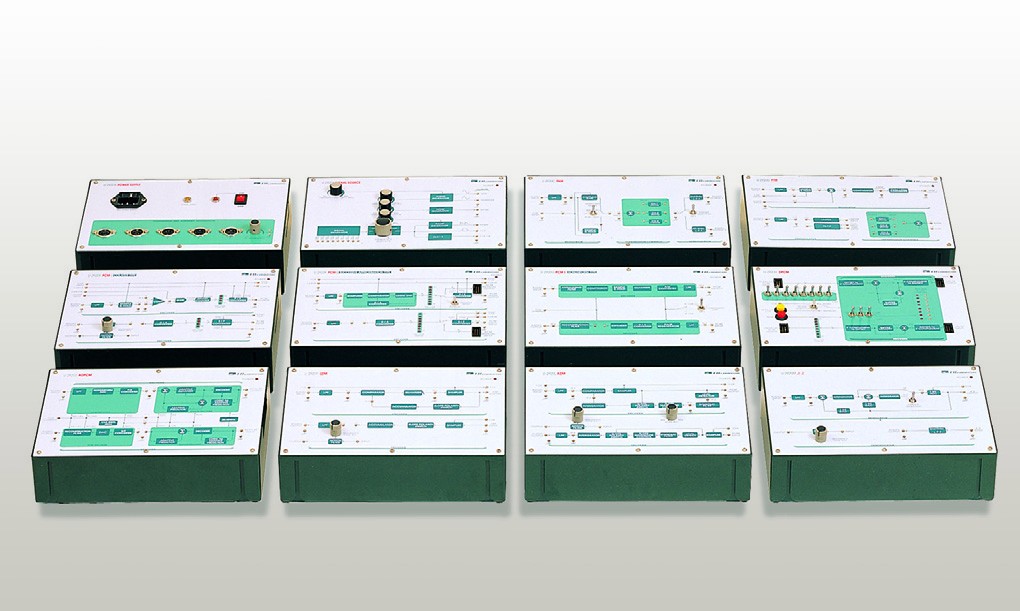
Pulse/Digital Communication Trainer ED-2920

Code: ED-2920


Datasheet PDF, 0.99 Mb

Description

EXPERIMENTS

  • PAM
    • To Understand PAM Signal Generation Which Makes an Example of Natural and Flat-Top
    • To Know the Impact of Sampling Signal Frequency on PAM Signal At the Time Domain
  • PTM
    • To Understand PTM (Pulse Time Modulation) Signal Generation Methods
    • To Understand PTM Signal Characteristics at the Time Domain
    • To Understand the Relationship Between PWM Signal and PPM Signal
  • PCM
    • To Understand A/D and D/A Conversion Processes
    • To Understand the cCounter-type A/D Conversion System
    • To Understand the Parallel-type D/A Conversion System
  • PCM
    • To Understand the Successive Approximation-type A/D Conversion System
    • To Understand PCM Signal Transmission Methods
  • PCM
    • To Understand the µ-law and µ-law Companding Characteristic Curves
    • To Understand the Influence of Companding on Demodulation Signal
  • DPCM
    • To Know the Methods of DPCM Signal Generation and Message Signal Demodulation
    • To Know the Offset Binary Code, 2’s Complement Code and Signed Binary Code
  • ADPCM
    • To Know the Relationship Between PCM CODEC’s Operation Principle and Its Timing
    • To Know the Relationship Between ADPCM System’s Operation Principle and ADPCM Transcoder’s Timing Diagram
  • LDM
    • To Know LDM Signal Generation and Message Signal Demodulation Methods
    • To Know the Shapes of Slope Overload Noise and Granular Noise Generated in ?M System
  • ADM
    • To Know ADM Signal Generation and Message Signal Demodulation Methods
    • To Know the Methods of Oblique Overload Noise Prevention in CVSD Demodulation System
  • ?-?
    • To Know ?-? Demodulation Principles and S/N Improvement Methods
    • To Know the Impact of Oversampling and Noise Shaping On the S/N Ratio at  ?-?Eemodulation


Features:

  • Modularized by each communicarion type
  • PAM, PTM, PCM, DPCM, ADPCM, LDM, ADM, Delta-sigma
  • No need to have additional generators (built-in power supply and signal source)
  • Can display the test point and measure signals using an oscilloscope
 

More products ED

CDMA TRAINING KIT ED-2945

• Rich experiments devoted to IS95 standard
• Easy-to-follow structure as main functions are itemized in modules


LOGIC LAB UNIT ED-1000BS

• Hi/Lo Logic Switch
• BCD hexadecimal indication LED
• Built-in DC power supply(+5V,+9V,±15V)
• Voltage and current meter
• DC overload alarm and indication
• Variable and single pulse generator


ELECTRONICS DEMONSTRATION SYSTEM ED-2300

• 24 Experimental Boards in two sections : (A) Semiconductor and (B) Electronic Circuit
• Experimental Board rack and board storage cabinet


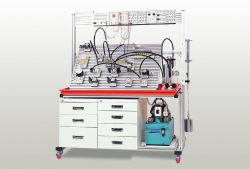
HYDRAULICS TRAINER ED-7960

• Convenient parts fixation by ‘one-touch lever’ bases and aluminum profile structure
• Efficient space utilization by mounting parts horizontally/vertically
• 64 hydraulic and electrical/electronic parts plus 20 types of optional components.
• Various hydraulic devices and components for Flexible Manufacturing System


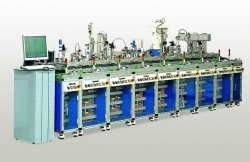
COMPUTER-INTEGRATED MANUFACTURING TRAINER ED-CIM

• Computer-Integrated Manufacturing Training System under the application of advanced control technology for real field experiences
• Capable of "per unit" configuration into the two or more processes, or entire processes for customized experiments by combining each process


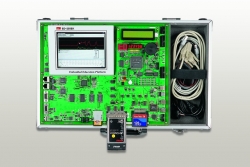
EMBEDDED SOFTWARE DESIGN PLATFORM ED-255EK

• Basic to advanced learning courses for Embedded Linux
• Intel PXA255(400MHz) high-performance microprocessor
• 6.4TFT LCD, Ethernet 2port, Serial 3port, PCMCIA/CF/MMC interfaces
• FPGA Chip(Altera Cyclone 120,000Gate) mounted for SoC experiments
• Reliable hardware and abundant experiment contents for programming


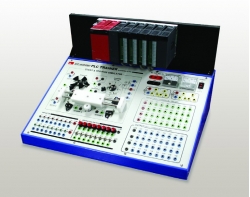
SMALL DESKTOP TYPE PLC TRAINER ED-4260MD

• Small desk type structure for space optimization
• Built-in DC power supply for convenience
• Handy experiments on the basic and application programming commands
• Base structure capable of expansion by mounting the special modules


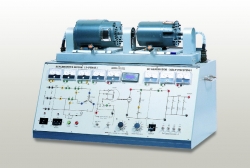
SYNCHRONOUS MOTOR(3-PHASE)/DC GENERATOR MG-5215

• Start and Sync characteristics of synchronous motor
• V-curve characteristics of synchronous motor
• Synchronous motor’s loss and efficiency
• Load characteristics of self-excited shunt-wound generator


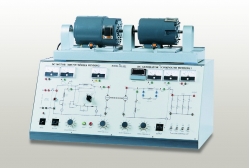
DC MOTOR/ GENERATOR MG-5211

• Load characteristics of DC compound motor
• Cumulative compound and differential compound characteristics
• Generator’s rotating speed and output characteristics
• Loss and efficiency of DC compound generator


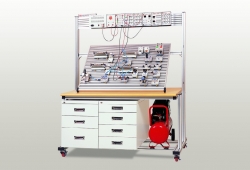
PNEUMATICS TRAINER ED-7860

• Convenient parts fixation by ‘one-touch lever’ bases and aluminum profile structure
• Efficient space utilization by mounting parts horizontally/vertically
• A complete pneumatic training system to help achieve advanced level of skills and obtain pneumatic engineering related licensesOver